
Double Jacket Sheath Protects Network Connection Further
Double jacket with greater crush resistance protects the fibre optic core and increases the strength and durability of the fibre.
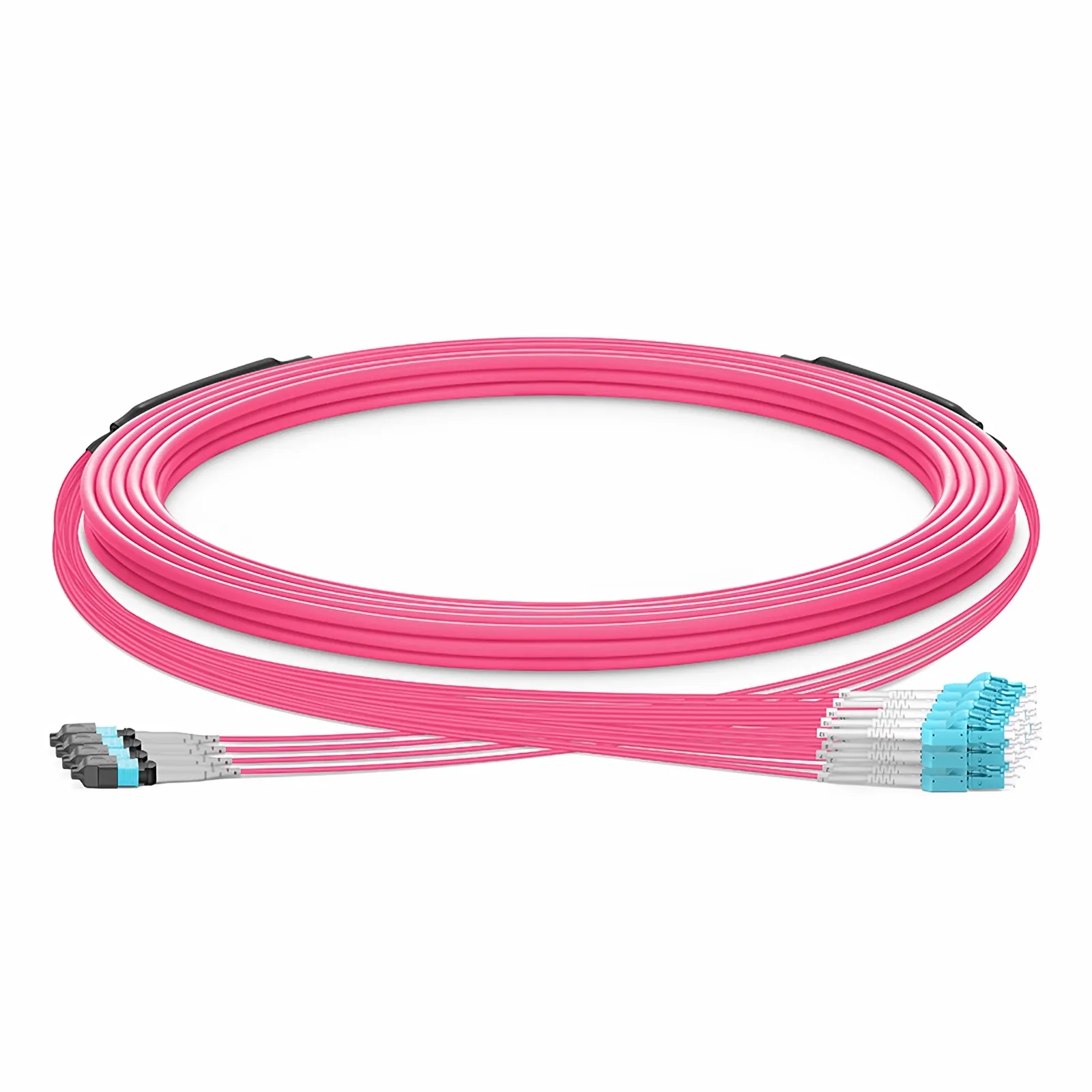
Customized MTP®-8 Hybrid Trunk Cable, 8-144 Fibers, Multimode (OM4), Plenum (OFNP), 0.20dB Max, Double Jacket, Product Specification:Connector A - US Conec MTP® Elite Female/Male, Connector B - LC UPC Uniboot (Duplex), Fiber Mode - OM4 50/125μm, Wavelength - 850/1300nm, Glass Fiber - Bend Insensitive Fiber, Minimum Bend Radius - 7.5mm
| Connector A | US Conec MTP® Elite Female/Male |
| Connector B | LC UPC Uniboot (Duplex) |
| Fiber Mode | OM4 50/125μm |
| Wavelength | 850/1300nm |
| Glass Fiber | Bend Insensitive Fiber |
| Minimum Bend Radius | 7.5mm |
| Polish Type | UPC to UPC |
| Polarity | Type A/Type B |
| Cable Jacket | Plenum (OFNP)/LSZH |
| Cable Structure | Double Jacket |
| Fiber Count | 8-144 Fibers (Base-8) |
| Trunk Outside Diametre (OD) | 3.6-11.2mm |
| Breakout Outside Diametre (OD) | 2.0mm |
| Breakout Length | 0.84m (MTP®), 0.91m (LC) |
| MTP Connector IL | ≤0.20dB<br/> |
| MTP Connector RL | ≥27dB |
| LC Connector IL | ≤0.15dB |
| LC Connector RL | ≥20dB |
| Attenuation at 850nm | ≤2.3dB/km |
| Attenuation at 1300nm | ≤0.6dB/km |
| Long-term Tensile Load<br/> | 100-200N |
| Short-term Tensile Load<br/> | 300-660N |
| Operating Temperature | OFNP: -10 to 60°C (14 to 140°F)<br/>LSZH: -10 to 70°C (14 to 158°F) |
| Storage Temperature | OFNP: -10 to 70°C (14 to 158°F)<br/>LSZH: -20 to 70°C (-4 to 158°F) |
Double jacket with greater crush resistance protects the fibre optic core and increases the strength and durability of the fibre.
MTP® cables are offering state-of-the-art multi-fibre and mechanical performance.
MTP® connectors utilise two alignment pins on one connector and two holes on the opposite connector. Female connectors can be identified by the two cable pins on the end of the connector.
The pulling eye protects fibre trunk connectors during cable installation and removal, particularly in tight spaces or hard-to-reach spaces, by fully covering the breakout length and transferring pulling force from the assembly to the sleeve.