
Flexible and Dense Ports with 1G/2.5G/5G/10G/100G for Versatile Networking
- 2.56 Tbps
- 1904 Mpps
- 36MB
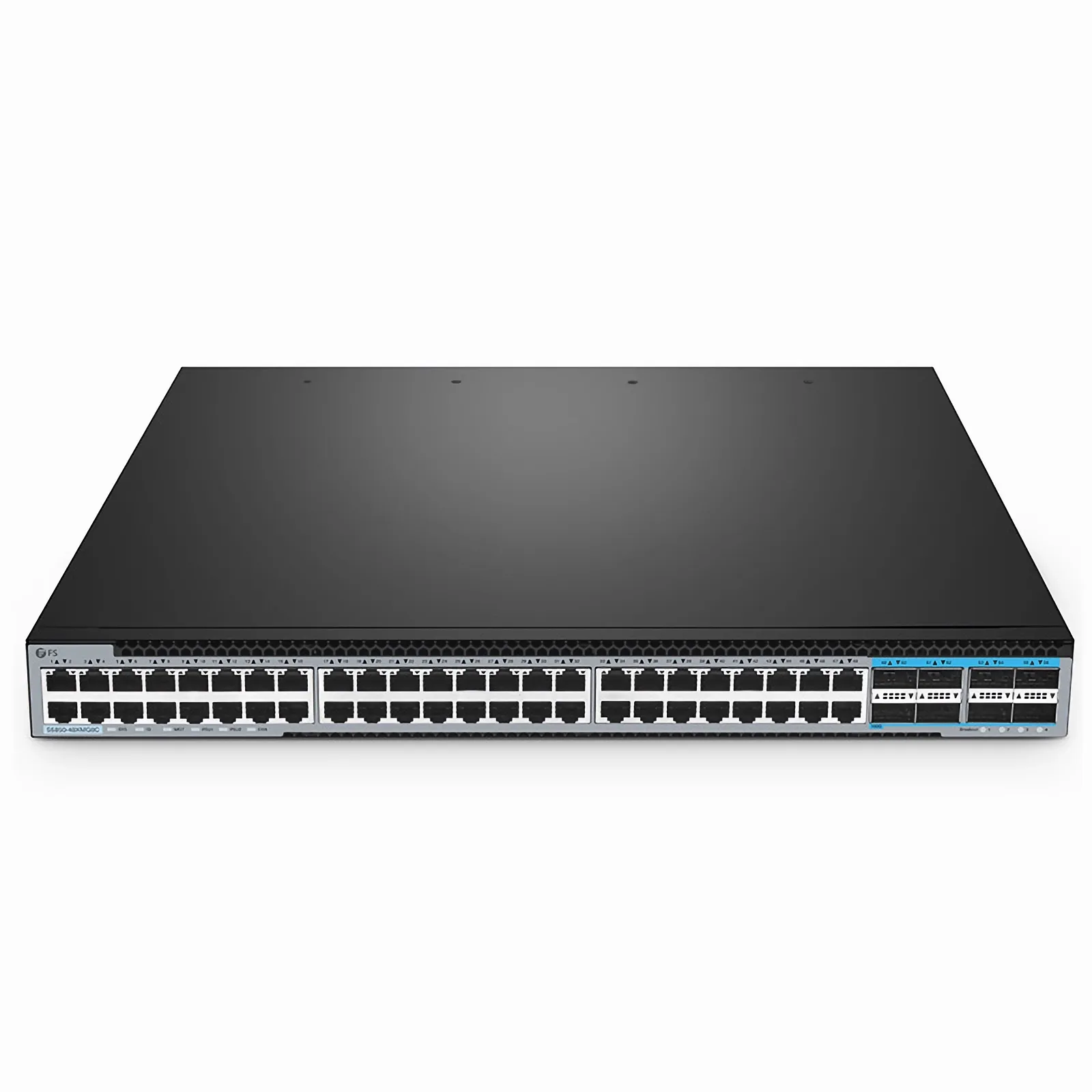
S5850-48XMG8C, 48-Port Ethernet L3 Switch, 48 x 10GBASE-T/Multi-Gigabit, with 8 x 100Gb QSFP28, Support MLAG, Product Specification:Ports - 48x 100/1000M/2.5G/5G/10GBASE-T | 8x 40/100G QSFP28 (split to 4x 10/25G), Switching Capacity - 1.28 Tbps (unidirectional)/2.56 Tbps (bidirectional), Power Supplies - 2 (1+1 Redundancy) Hot-swappable, Forwarding Rate - 1904 Mpps, Fans - 4 Hot-swappable, Front-to-Back, Packet Buffer - 36MB
| Ports | 48x 100/1000M/2.5G/5G/10GBASE-T | 8x 40/100G QSFP28 (split to 4x 10/25G) |
| Switching Capacity | 1.28 Tbps (unidirectional)/2.56 Tbps (bidirectional) |
| Power Supplies | 2 (1+1 Redundancy) Hot-swappable |
| Forwarding Rate | 1904 Mpps |
| Fans | 4 Hot-swappable, Front-to-Back |
| Packet Buffer | 36MB |
| Dimensions (HxWxD) | 1.73''x11.41''x16.54''(44x442x420mm)<br/> |
| Jumbo Frame | 9600 |
| Form Factor | 1RU |
| MTBF | ≥ 90000 |
| Weight | 8.18kg (18.04 lbs) |
| MAC Address | 122880 |
| Input Voltage | 100-240VAC, 50-60Hz |
| IPv4/IPv6 Routes | 60K/4K |
| Input Current | 7A (MAX) |
| Number of VLANs | 4K |
| Max. Power Consumption | 260W |
| DRAM | 2GB |
| Operating Temperature | 0 to 45ºC (32 to 113°F) |
| Flash Memory | 8GB(eMMC) |
The dual power supplies can be replaced without shutting down the system, and the variable-speed fans with front-to-back airflow automatically adjust fan speed to reduce power draw.
Easily scale, build resiliency, and simplify resource management with EVPN-VXLAN-based campus fabrics. With a single physical network (Underlay) creating virtual networks (Overlay), these fabrics enable tenant isolation and native traffic segmentation, ensuring critical services remain uninterrupted while enhancing security and flexibility.
MLAG delivers device-level link redundancy and load balancing by aggregating links across two switches, boosting network bandwidth, reliability, and availability, ensuring uninterrupted operation of critical services.
BC/TC/OC modes can be flexibly configured based on factors such as the scale of the network and the application scenario to meet the time accuracy requirements.